Running a giveaway in a guild is more often a trust problem than a randomness problem. Pulling a name out of a hat is technically fair. But unless everyone watches the hat, half the guild quietly assumes the winner was decided in advance — usually by an officer they're already half-frustrated with for unrelated reasons.
A visible animated draw fixes that. A server-side animated draw fixes it without giving the host any way to influence the outcome. Raidium's raffle tool is built around both of those ideas, and ships with five different animation styles depending on what kind of energy you want for the event.

The trust problem in guild giveaways
Most guilds have run at least one of these:
- Discord roll bot — fast, but the result appears in a chat line and feels anticlimactic.
- A spreadsheet randomiser — visible to no one but the host. Trust falls back on the host's reputation.
- A name-out-of-a-hat stream — entertaining, but only meaningful if everyone happens to be online at the moment of the draw.
The failure mode is the same in all three cases: the act of randomising and the act of revealing happen in the same place, controlled by the same person. There's no separation between who decides the winner and who shows the result.
Raidium's raffle splits those two responsibilities. The server picks the winner the moment a draw is triggered — it stamps a winnerIndex, a drawnAt timestamp, and the user who triggered the draw. The animation that members see afterwards is a presentation layer rendering a result that was decided server-side. The host cannot influence what comes out of the spin, because by the time anyone sees an animation frame, the winner is already in the database.
The five animation styles
The tool ships with five styles. Each one fits a different kind of event.
- Wheel — the classic. A coloured wheel with each entrant's name on a wedge, spins and lands on a winner. Best for medium-sized events (10–40 entrants) where you want everyone's name visibly in the running.
- Slot machine — names cycle in a vertical reel and land on the winner. Faster pacing than the wheel, plays well with smaller participant counts, and reads cleanly on a phone.
- Gacha — a card-pull animation that tilts the experience toward gaming-flavoured suspense. Good for items that are themselves loot drops, or for guilds whose culture leans MMO-flavoured.
- Find the maid — a shuffle-and-pick animation with personality. Lighter, sillier — best when the prize is fun rather than serious (cosmetic, gold pile, gag prize).
- Battle royale — entrants are eliminated in rounds until one remains. Longest pacing, highest engagement, ideal for big events where you want the draw itself to be the entertainment.
None of them affect the outcome. The server already knows who won the moment you click draw. The animation just needs to land on the right name, and each style has its own way of building tension toward that reveal.
What a host configures
Creating a raffle takes seconds:
- A title for the event ("Friday night T2 weapon giveaway")
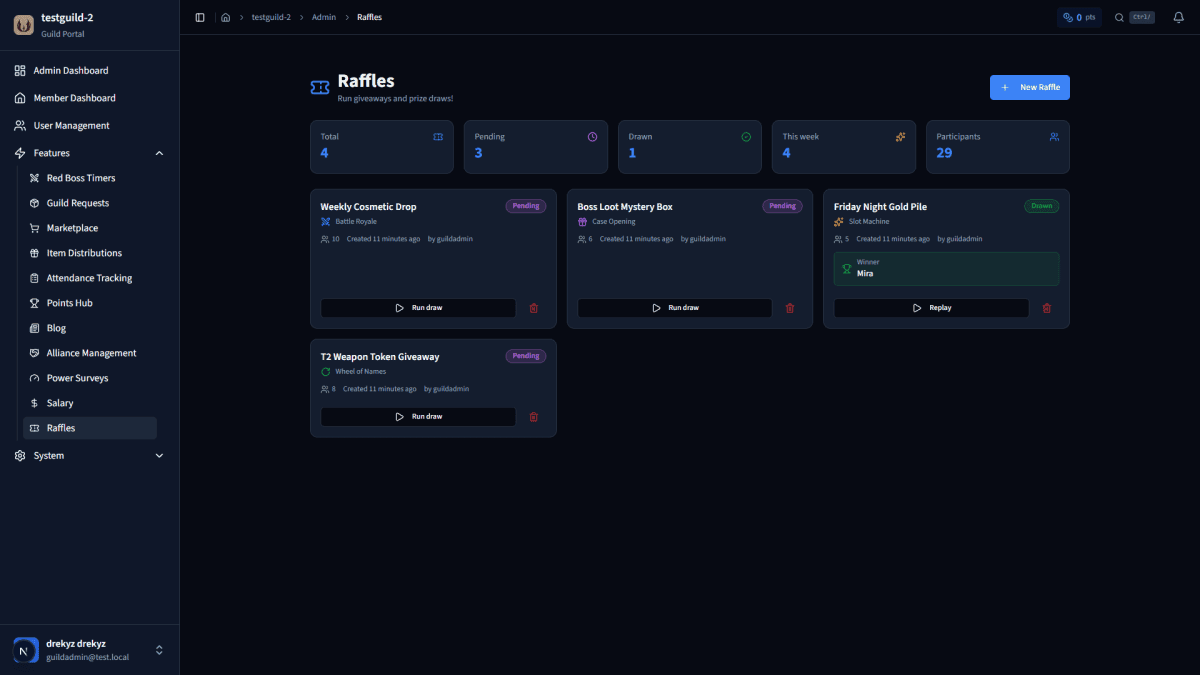
- A list of participants — minimum 2, maximum 200. You can either type names freeform or attach guild member IDs for prizes that need to land on a specific account.
- An animation style from the five above.
- A duration between 5 and 60 seconds. The default of 30 hits a good balance — long enough to build tension, short enough not to drag.
That's it. The raffle is created in pending status until someone triggers the draw, at which point it transitions to drawn and the winner is locked in.

Why participant count matters
The tool caps participant lists at 200 for a reason: the wheel and slot animations stop being legible past a few dozen entries, and the engagement value of a draw drops as your odds approach zero. If you're running giveaways with hundreds of entrants, you're past the point where a visible-randomiser tool helps — you'd be better served by a weighted contribution-based distribution model than a flat raffle.
The minimum of 2 is enforced for the obvious reason. A one-entrant raffle is not a raffle.
Self-cleanup with a 90-day TTL
Raffles aren't archive material. A guild that runs weekly giveaways will accumulate hundreds of records over a year, none of which anyone is going to read again after the prize is handed out.
Raidium handles this with a MongoDB TTL index on the raffle's creation date — every raffle automatically purges 90 days after it's created. The drawn winner is preserved long enough for any disputes to surface (a few weeks is more than enough in practice), then it's gone. Officers don't have to remember to clean up; the database does it for them.
If you need a permanent record of a specific draw — a tournament prize, a high-value item — screenshot the result page when it's revealed. The 90-day window is generous for routine events, but explicit archival is the right tool when you actually need long-term proof.
How to run a raffle in your guild
- Open
Admin → Rafflesand create a new raffle. - Type the title, paste in the participant list, and pick an animation style.
- Save the raffle. It's now in
pendingand visible in the raffle list. - When you're ready to draw — typically with the guild watching in voice or stream — click
Draw winner. The server picks the winner the instant you click, and the animation begins playing. - The winner is revealed at the end of the animation and persisted to the raffle record.
The whole flow is designed so the moment of suspense is real for everyone, including the host. You click draw, the server decides, the animation plays — and the result is the same regardless of who was running the event or what device they were on.
That's the point. Trust shouldn't depend on who's holding the spreadsheet.