Some content in MMORPGs can't be cleared by a single guild. Whether it's a world boss that requires 100+ players, a contested zone that demands territorial control, or simply a mutual defense agreement against rival factions — alliances between guilds are a fundamental part of endgame play.
But alliances create a management problem that's an order of magnitude harder than running a single guild. When loot drops and three guilds contributed players, who gets what? When the alliance kills a boss every day for a month, how do you ensure the rotation is actually fair? This guide covers the unique challenges of multi-guild alliance management, how to set up loot rotation systems that don't collapse under politics, and how to track funds distribution across guild boundaries.
What Alliances Look Like in Practice
An MMORPG alliance is typically 2-5 guilds that cooperate for content they can't or don't want to solo. The cooperation usually involves:
- Shared boss kills: Multiple guilds contribute players to take down high-value targets
- Territory control: Guilds coordinate to hold zones, castles, or nodes against rival alliances
- Resource sharing: Guilds trade materials, crafting services, or intel
- Mutual defense: If one guild gets attacked, allied guilds respond
The social dynamics are complex. Each guild has its own leadership, its own culture, its own internal loot system. The alliance needs coordination mechanisms that respect each guild's autonomy while ensuring fairness across the group.
The Core Challenge: Fair Loot Rotation
Single-guild loot distribution is already hard. Alliance loot distribution is exponentially harder because you're balancing fairness across organizations, not just individuals.
Here's why it breaks down:
No Shared Economy
Guild A uses DKP. Guild B uses loot council. Guild C uses random roll. You can't compare a player's 500 DKP from Guild A to a loot council decision from Guild B. There's no common currency for value.
Contribution Imbalances
Guild A sent 30 players to the boss fight. Guild B sent 15. Guild C sent 5. Does Guild A get 60% of the loot? Or does each guild get equal shares regardless of headcount? Both approaches feel unfair to someone.
Trust Deficits
Within a guild, members generally trust their officers. Across guilds, that trust doesn't transfer. Guild B's leader doesn't necessarily trust Guild A's loot master, and vice versa. Without a neutral system, every allocation decision breeds suspicion.
Political Pressure
Guild leaders face pressure from their own members to "fight for our share." Even if the alliance agreement is fair on paper, individual members see loot going to another guild and feel shortchanged. Leaders who don't advocate aggressively lose credibility with their own roster.
Loot Rotation Models That Actually Work
After two decades of MMORPG alliances, a few rotation models have proven stable. Each has tradeoffs.
Round-Robin by Guild
The simplest model. Guilds take turns getting loot priority. Kill 1: Guild A picks first. Kill 2: Guild B. Kill 3: Guild C. Repeat.
Pros:
- Dead simple to understand and track
- Every guild gets equal opportunities over time
- No arguments about individual kills
Cons:
- Doesn't account for contribution differences
- A guild that sends 5 players gets the same rotation as one that sends 30
- Requires consistent participation — if a guild skips their turn, does it carry over?
Best for: Alliances where all guilds contribute roughly equally.
Weighted Rotation
Guilds earn rotation priority based on contribution — number of players sent, roles filled, consumables provided. Higher contribution = more frequent priority.
Pros:
- Rewards effort proportionally
- Motivates guilds to contribute fully
- Feels fair to high-contribution guilds
Cons:
- Requires tracking contribution metrics across guilds
- Smaller guilds may feel permanently disadvantaged
- Metrics need to be agreed upon in advance
Best for: Alliances with significant size differences between guilds.
Shared Pool with Guild Allocation
All loot goes into a shared pool. After the event, alliance leadership allocates items to guilds based on pre-agreed percentages. Each guild then distributes internally using their own system.
Pros:
- Maximum flexibility
- Each guild maintains its internal loot system
- Can adjust allocation percentages as contributions shift
Cons:
- Alliance leadership role becomes a political hot seat
- Allocation decisions will be questioned
- Requires strong inter-guild trust
Best for: Established alliances with trusted cross-guild leadership.
Setting Up Alliance Agreements
Every stable alliance runs on a written agreement. Verbal handshakes work for a week. Here's what your alliance agreement needs to cover:
Membership Terms
- Which guilds are in the alliance?
- How do new guilds join? (Invitation? Application? Unanimous vote?)
- How does a guild leave? What's the notice period?
- Under what conditions can a guild be removed?
Contribution Expectations
- Minimum player count per guild for alliance events
- Role requirements (tanks, healers, DPS ratios)
- Consumable expectations
- Attendance tracking method
Loot Rotation Rules
- Which rotation model are you using?
- How is rotation order determined initially?
- What happens when a guild misses an event?
- How are high-value vs. low-value items handled differently?
- Who resolves disputes?
Funds Distribution
Boss kills often generate currency, materials, or sellable items in addition to gear. How these funds are split matters:
- Equal split: Each guild gets the same share regardless of contribution. Simple but potentially unfair.
- Proportional split: Based on headcount or contribution metrics. Fair but requires tracking.
- Rotation-based: The guild with loot priority also gets the bulk of funds for that kill.
Tracking Loot Rotation Across Guilds
The biggest operational challenge in alliance loot management is tracking. Who got priority last? What's the current rotation position? How many kills has each guild received priority for this month?
Manual tracking — spreadsheets shared between guild leaders — works until someone forgets to update it, enters the wrong data, or loses access to the document. Sound familiar? It's the same problem as single-guild DKP tracking, but across organizational boundaries where trust is lower and stakes are higher.
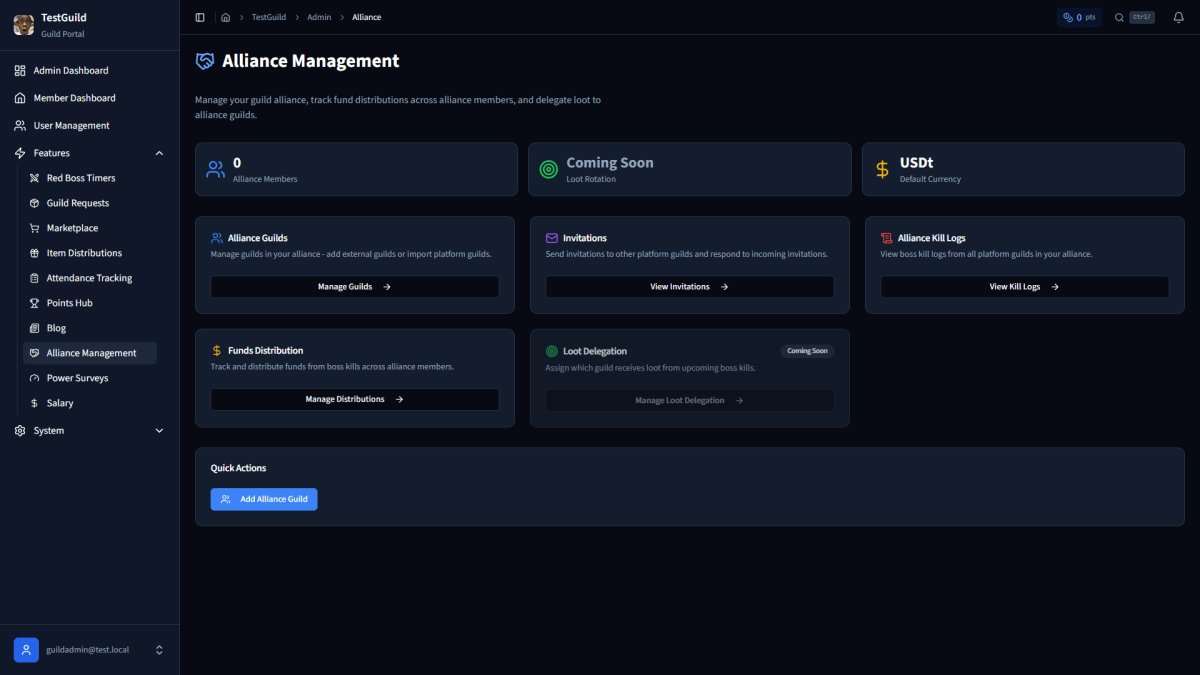
This is where purpose-built tools make a significant difference. Raidium's alliance management system handles:
- Alliance member tracking: Which guilds are in the alliance, their membership status, and invitation lifecycle
- Loot rotation configuration: Automated rotation tracking so every guild can see the current position
- Funds distribution records: Logged distributions from kill events, visible to all alliance members
- Kill log integration: Boss kills automatically tie into the rotation and distribution system
The key advantage of an automated system is that it's neutral. No single guild controls the spreadsheet. Every guild sees the same data. Disputes are resolved by checking the log, not by arguing over who updated what.
Common Alliance Failures and How to Avoid Them
Failure: No Written Agreement
Two guild leaders shake hands on a "fair" rotation. Three weeks later, they disagree on what "fair" means. Neither has documentation to reference.
Prevention: Write it down before the first joint kill. Publish the agreement where every member of every guild can read it.
Failure: Contribution Resentment
Guild A consistently sends 25 players while Guild B sends 8. Guild A's members start openly questioning why they're sharing loot equally.
Prevention: Set minimum contribution requirements in the agreement. If a guild consistently falls below minimums, address it at the leadership level before resentment boils over. Consider weighted rotation if size differences are structural.
Failure: Communication Breakdown
Alliance boss kill is scheduled for Saturday at 20:00. Guild A announces it in their Discord. Guild B's leader forgot to relay the message. Half of Guild B doesn't show up.
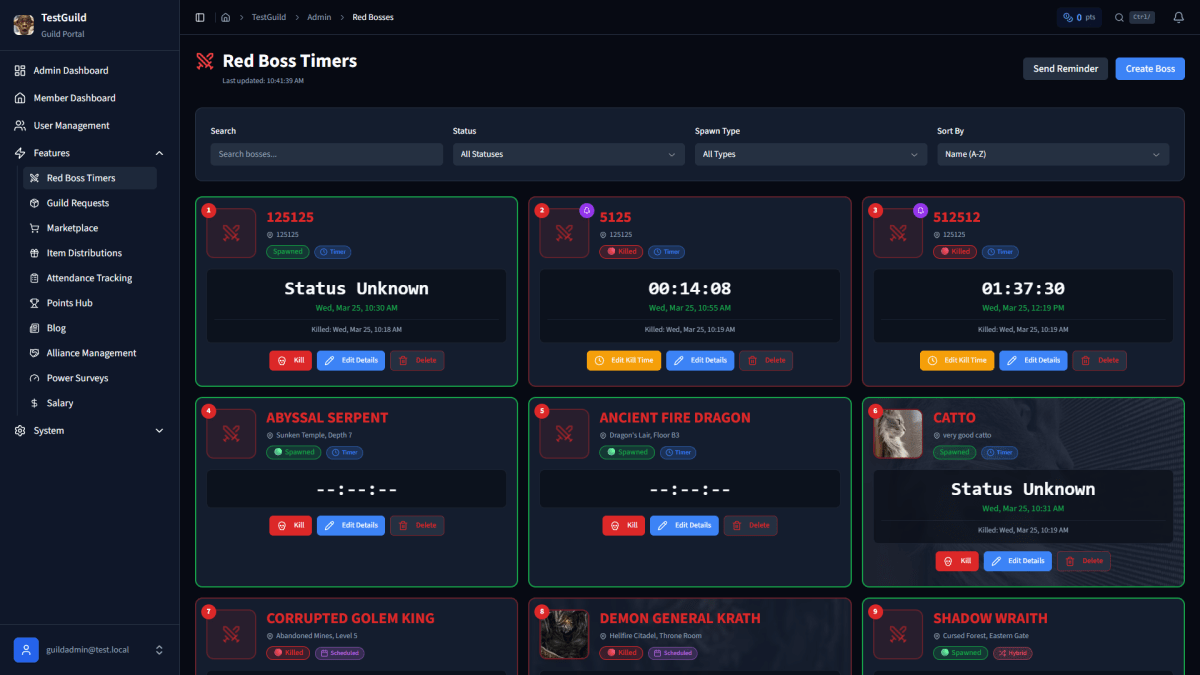
Prevention: Establish a shared communication channel — a cross-guild Discord server or a dedicated alliance channel that all leaders monitor. Use automated reminders that reach all alliance members, not just one guild's channel.
Failure: Leadership Vacuum
Nobody is officially responsible for alliance operations. Decisions happen ad hoc. When a dispute arises, there's no authority to resolve it.
Prevention: Designate an alliance coordinator role that rotates between guilds. This person manages scheduling, confirms rotation positions, and arbitrates disputes. The role should rotate to prevent any single guild from accumulating too much influence.
Scaling Your Alliance
Alliances work best with 2-4 guilds. Beyond that, coordination costs start to outweigh benefits. If you're considering expanding:
- Add guilds slowly. One at a time, with a probation period.
- Vet leadership compatibility. The most common alliance-breaking conflict is between leaders, not members.
- Increase structure with size. A 2-guild alliance can run on informal agreements. A 5-guild alliance needs formal processes, documented rules, and automated tracking.
- Plan for exits. Guilds will leave. Make the exit process clean so it doesn't become a war.
Making Alliances Sustainable
The alliances that last are the ones that invest in infrastructure. Written agreements, automated tracking, neutral systems, and clear communication channels transform a fragile political arrangement into a durable operational partnership.
Most alliance drama comes from the same source as most guild drama: unclear rules, manual tracking, and lack of transparency. Solve those three problems and your alliance will survive the political pressures that tear most multi-guild partnerships apart.