Every guild leader has been there. A rare weapon drops, two players claim they deserve it, and suddenly your Discord is on fire. Loot drama has destroyed more guilds than any raid boss ever could. The good news: it's a solvable problem — if you pick the right loot distribution system and stick to it.
This guide breaks down why loot disputes happen, compares the most common distribution systems, and shows you how a points-based marketplace can eliminate arguments entirely.
Why Loot Drama Happens in the First Place
Loot drama rarely starts because someone is greedy. It starts because the rules are unclear, inconsistently applied, or feel unfair to specific players.
Here are the most common triggers:
- Unclear rules: Nobody wrote down how loot gets distributed, so every drop becomes a negotiation.
- Inconsistent enforcement: Officers give loot to friends, or bend rules "just this once" until trust erodes.
- No history tracking: When nobody can prove who got what last week, accusations fly.
- Effort mismatch: A player who shows up to every raid watches a casual member win a best-in-slot item on their first run.
- Perceived bias: Even fair systems feel unfair when there's no transparency.
The root cause is almost always the same: manual processes with no accountability trail.
Common Loot Distribution Systems Compared
Let's break down the four most popular approaches and where each one falls apart.
Random Roll (Need/Greed)
The simplest system. Item drops, eligible players roll, highest number wins.
Pros:
- Zero setup required
- Everyone understands it instantly
- No officer overhead
Cons:
- Pure luck rewards inconsistency — a player could win three items in one raid while a veteran gets nothing for months
- No way to factor in attendance, effort, or contribution
- Leads to "loot and scoot" behavior where players leave after winning
Best for: Casual guilds with low-stakes content where nobody cares much about optimization.
DKP (Dragon Kill Points)
Players earn points for attending raids and spend them to bid on loot. Highest bidder wins.
Pros:
- Rewards consistent attendance
- Creates a measurable economy
- Transparent — everyone can see point balances
Cons:
- Hoarding: veterans stockpile points and snipe every high-value drop
- Inflation: point values become meaningless over time without decay
- New member penalty: fresh recruits can't compete for months
- Manual tracking is error-prone and time-consuming
Best for: Guilds willing to maintain spreadsheets and manage decay mechanics.
EPGP (Effort Points / Gear Points)
Players earn EP for effort (attendance, consumables) and accumulate GP when they receive gear. Priority = EP / GP. Highest priority wins.
Pros:
- Built-in anti-hoarding (GP ratio naturally balances)
- Rewards effort, not just attendance
- Decay applies to both EP and GP, keeping the system fresh
Cons:
- More complex to understand than DKP
- Still requires manual tracking or addons
- Decay rates need constant tuning
- Doesn't work well across different content types
Best for: Progression-focused guilds with officers who enjoy spreadsheet optimization.
Loot Council
A panel of officers decides who gets each item based on need, performance, and attendance.
Pros:
- Most strategically optimal — items go to players who benefit the guild most
- Can account for nuance that point systems miss
Cons:
- Requires absolute trust in the council
- Perceived favoritism is almost impossible to avoid
- Scales terribly — works for 10-person raids, breaks at 40+
- Officer burnout is real when every drop requires a committee decision
Best for: Small, tight-knit groups with high trust and experienced leadership.
Why Most Loot Systems Still Fail
Notice the pattern? Every traditional system either relies on luck (random roll), manual tracking (DKP/EPGP), or subjective judgment (loot council). All four share a fatal flaw: they depend on humans to be consistent, fair, and tireless.
Spreadsheets get abandoned. Officers forget to log points. Council decisions accumulate resentment. The system starts strong and degrades over months until someone rage-quits and posts a callout thread.
How a Points-Based Marketplace Eliminates Loot Drama
The best loot distribution system isn't a distribution system at all. It's an economy.
Here's the concept: instead of distributing loot directly, players earn points through measurable contributions — attending boss kills, showing up for events, participating consistently. Then they spend those points in a marketplace where items are listed at set prices or auctioned.
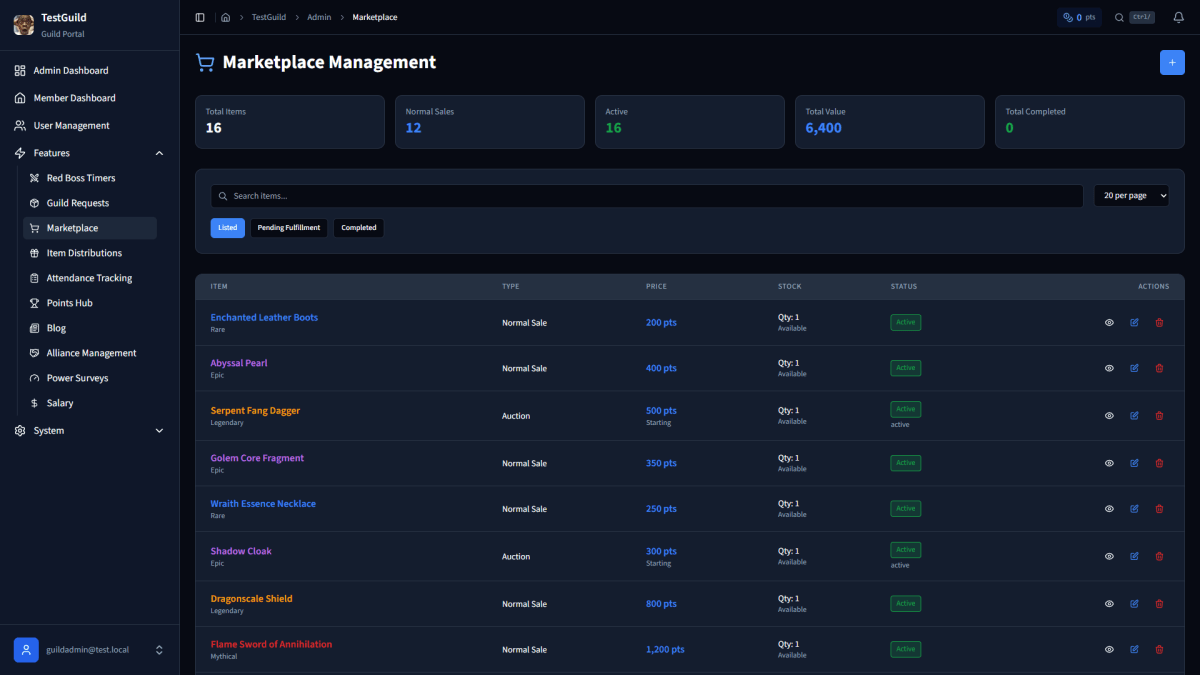
This approach solves every problem we've discussed:
- No arguments over drops: Items go to the marketplace, not to a roll or a council vote. Players decide what to spend on.
- Effort is always rewarded: Points accumulate from attendance and kills, so consistent players always have more purchasing power.
- Full transparency: Every point earned and spent is logged automatically. No hidden spreadsheets.
- Self-regulating economy: High-demand items naturally cost more (especially with auctions), so the market balances itself.
- New members aren't locked out: They start earning immediately and can compete for lower-tier items while building up to big purchases.
How It Works in Practice
- Points are earned automatically when attendance is recorded for boss kills (e.g., 200 points for a red boss kill, 10 for a guild boss).
- Officers list items in the marketplace at fixed prices or as auctions.
- Players browse and buy — points are reserved atomically so there's no double-spending.
- Auctions run on timers with automatic resolution, so nobody needs to babysit the process.
- Full audit trail tracks every transaction, point change, and purchase.
The result: loot goes to the players who earned it, through a system that runs itself.
Setting Up a Drama-Free Loot System
If you're ready to switch, here's a practical checklist:
- Define point values clearly. How many points per boss type? Per event? Write it down and make it visible.
- Set marketplace prices before drops happen. Don't price items after they drop — that's just loot council with extra steps.
- Use auctions for rare items. Let the market decide what a legendary drop is worth.
- Automate everything you can. Manual tracking is where fairness goes to die. Tools like Raidium handle point calculation, marketplace listings, and transaction logging automatically.
- Publish the ledger. When everyone can see point balances and transaction history, conspiracy theories die.
The Bottom Line
Loot drama isn't a people problem. It's a systems problem. Random rolls are unfair, DKP is gameable, EPGP is complex, and loot councils breed resentment. A points-based marketplace gives every member agency over their own rewards while keeping the system transparent and self-sustaining.
Your guild's energy should go toward killing bosses, not arguing about who deserves the drops.