DKP — Dragon Kill Points — has been the backbone of guild loot management since EverQuest popularized it in 1999. Two decades later, guilds still use it because the core idea is sound: reward players who show up, let them spend those rewards on gear they want. But a poorly designed DKP system creates more problems than it solves.
This tutorial walks through building a fair DKP system from scratch, covers the pitfalls that ruin most implementations, and compares DKP to modern alternatives that automate what used to require hours of spreadsheet work.
What Is DKP and How Does It Work?
DKP is a point-based loot currency. Players earn points for participating in raids, boss kills, or other guild activities. When loot drops, players bid their accumulated DKP. The highest bidder wins the item and their point balance decreases by the bid amount.
The fundamental loop:
- Earn — Show up, get points
- Bid — Item drops, spend points
- Win — Highest bid takes the item
- Repeat — Keep attending, keep earning
Simple in theory. The complexity lives in the details.
Setting Up Your DKP System: Step by Step
Step 1: Define Point Earning Rules
Your earning structure determines what behavior gets rewarded. Be specific:
- Boss kill points: Award points per boss killed. Scale by difficulty — a farm boss shouldn't pay the same as progression content.
- Attendance points: Award points for showing up on time, staying for the full raid, and being prepared.
- Bonus points: Optional points for bringing consumables, filling needed roles, or exceptional performance.
Example structure:
- On-time attendance: 10 DKP
- Per boss kill (farm): 5 DKP
- Per boss kill (progression): 15 DKP
- Full clear bonus: 10 DKP
- Consumables prepared: 5 DKP
Step 2: Choose a Bidding Format
The three main DKP bidding formats each create different dynamics:
Open bidding: Players openly bid against each other. Creates a true market but encourages strategic manipulation and collusion.
Silent bidding: Players submit bids privately. Prevents manipulation but can feel opaque and leads to overbidding anxiety.
Fixed-price DKP: Items have set costs. Highest accumulated DKP wins ties. Simplest to run, but pricing items correctly is an art form.
For most guilds, fixed-price DKP is the best starting point. It's the easiest to track, hardest to game, and removes the negotiation element that causes friction.
Step 3: Set Item Prices
Price items before they drop, not after. Group items into tiers:
- Tier 1 (Best in slot): 100 DKP
- Tier 2 (Major upgrade): 60 DKP
- Tier 3 (Minor upgrade): 30 DKP
- Tier 4 (Off-spec / cosmetic): 10 DKP
Publish the price list where everyone can see it. Update it when new content releases, not mid-tier.
Step 4: Implement Decay
This is where most DKP systems live or die. Without decay, veterans accumulate massive point leads and new members can never compete.
Percentage decay (recommended): Reduce all balances by 10-20% weekly. This keeps the gap between veterans and newcomers manageable without wiping out earned progress.
Flat decay: Remove a fixed number of points weekly. Punishes low-balance players disproportionately. Avoid this.
Zero-sum DKP: Points spent by the winner are distributed among other raiders. Self-balancing but complex to track manually.
Decay rate guidelines:
- 10% weekly = gentle, veterans still have advantage
- 15% weekly = balanced, 6-8 week catch-up for new members
- 20% weekly = aggressive, equalizes quickly but may frustrate long-term players
Step 5: Handle Edge Cases
Every DKP system needs rules for situations that will absolutely come up:
- Tied bids: First come first served? Random roll? Attendance-based tiebreak? Decide now.
- Off-spec bidding: Can a DPS bid on healer gear? Usually yes, but at reduced priority or minimum bid.
- Absent bidding: Can a player bid on items if they had to leave early? Almost always no.
- Transfer restrictions: Can players trade DKP? Hard no — this creates a black market.
- New member starting balance: Zero is fine with proper decay. Some guilds give a small starting balance (20-30% of average) to prevent the "months of earning before you can bid" problem.
The 5 DKP Pitfalls That Destroy Guilds
Pitfall 1: Hoarding
Veterans stockpile thousands of points, refuse to bid on anything except best-in-slot items, and snipe every major drop. Meanwhile, everyone else feels like they're playing a rigged game.
Fix: Aggressive decay (15-20% weekly) and maximum point caps. Some guilds also implement "use it or lose it" rules where points above a cap are forfeited.
Pitfall 2: Inflation
When points enter the system faster than they leave, every balance grows but purchasing power stays flat. Numbers get absurd — players sitting on 50,000 DKP bidding against each other in increments of 5,000.
Fix: Balance point income against item costs. Total points earned per raid should roughly equal the total value of items that drop. Decay helps here too.
Pitfall 3: New Member Penalty
A new recruit joins your guild and can't meaningfully bid on anything for two months. They watch gear get sharded while they save up. Many quit before they ever compete.
Fix: Starting balances, aggressive decay (which compresses the gap), or a separate "newcomer priority" queue for items nobody else bids on.
Pitfall 4: Tracking Errors
Manual DKP tracking in spreadsheets is tedious and error-prone. One officer forgets to log a raid. Another miscounts a bid. Suddenly the ledger is wrong and nobody trusts it.
Fix: Automate. Whether it's addons, bots, or purpose-built tools, get humans out of the data entry loop.
Pitfall 5: Officer Burnout
The DKP officer role is a thankless job. Logging every raid, processing every bid, handling every dispute, updating the spreadsheet. Most DKP officers last 3-6 months before they hand off the role or quit the guild entirely.
Fix: Distribute the workload or — better — eliminate it with automation.
DKP vs. EPGP vs. Points-Based Marketplace
DKP isn't the only option. Here's how it compares to the main alternatives:
| Feature | DKP | EPGP | Points Marketplace |
|---|---|---|---|
| Anti-hoarding | Requires decay tuning | Built-in via ratio | Natural (spend to get) |
| New member fairness | Poor without fixes | Moderate | Good (immediate earning) |
| Tracking overhead | High (manual) | High (manual) | Low (automated) |
| Player agency | Bid on drops | Priority queue | Browse and buy anytime |
| Transparency | Moderate | Moderate | Full audit trail |
| Officer burden | Heavy | Heavy | Minimal |
EPGP improves on DKP's hoarding problem with its ratio system, but it adds complexity and still requires manual tracking.
A points-based marketplace takes the core DKP principle — earn points for effort, spend them on gear — and automates every painful part. Points are calculated from attendance records. Items are listed in a marketplace with set prices or auctions. Transactions are atomic and logged.
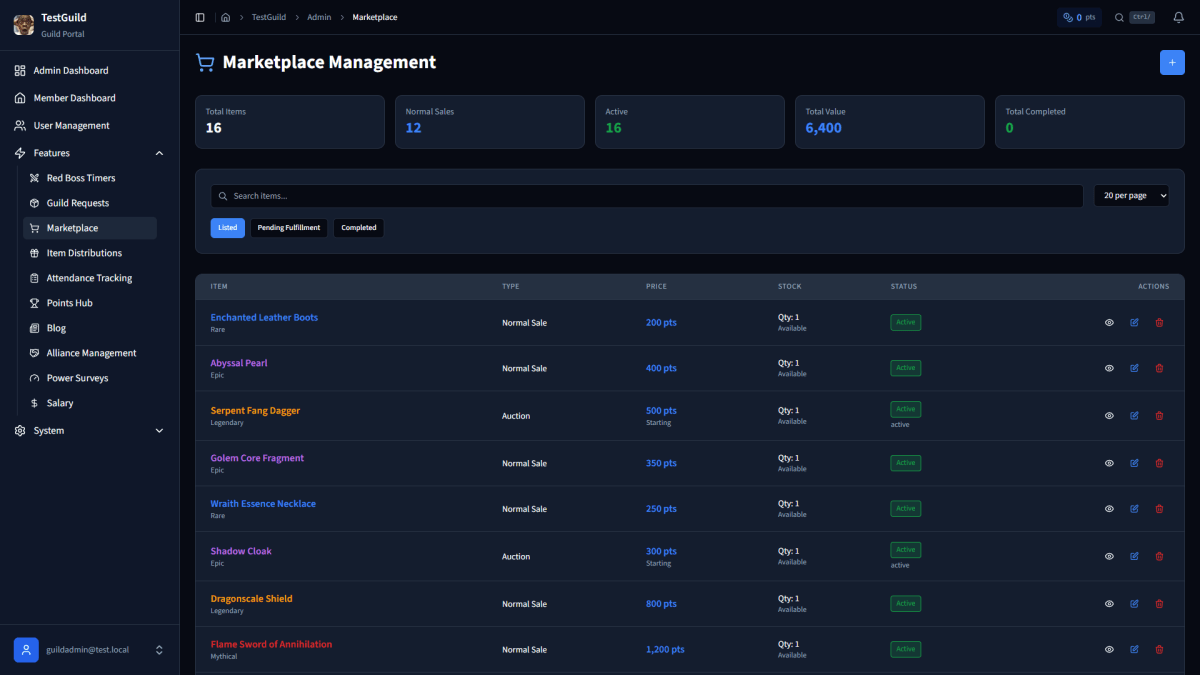
Tools like Raidium handle the point calculations, marketplace listings, and full transaction history automatically. The DKP officer role effectively disappears — the system runs itself.
Why Manual DKP Tracking Is a Losing Battle
Let's be honest about what manual DKP tracking looks like in practice:
- An officer has a Google Sheet open during every raid
- They tab out of the game to log attendance, kills, and bids
- After the raid, they spend 20-30 minutes reconciling numbers
- Players DM them with disputes: "I was there for that kill, you didn't count me"
- The spreadsheet link gets lost, shared incorrectly, or accidentally edited
- The officer goes on vacation and nobody updates it for two weeks
This workflow was acceptable in 2005. It's not anymore. Automated point systems track attendance through verified records, calculate points using defined rules, and let players see their balances and history in real time. No spreadsheets, no disputes, no burnout.
Making DKP Work If You're Committed to It
If you're set on running traditional DKP, here's the minimum viable setup:
- Write the rules document. Every earning rate, item price, decay rate, and edge case in one place. Pin it in Discord.
- Use 15% weekly decay. It's the sweet spot for most guilds.
- Fixed-price bidding. Remove the drama of open auctions.
- Assign two DKP officers. Redundancy prevents single points of failure.
- Audit monthly. Review the ledger publicly. Catch errors before they become accusations.
- Set a sunset date. If the system is causing more problems than it solves after 3 months, switch to an automated alternative.
DKP is a solid concept held back by manual execution. The guilds that make it work either invest heavily in officer discipline or eventually automate the process entirely. Either way, the principle remains true: reward effort, let players choose their rewards, and keep everything transparent.